
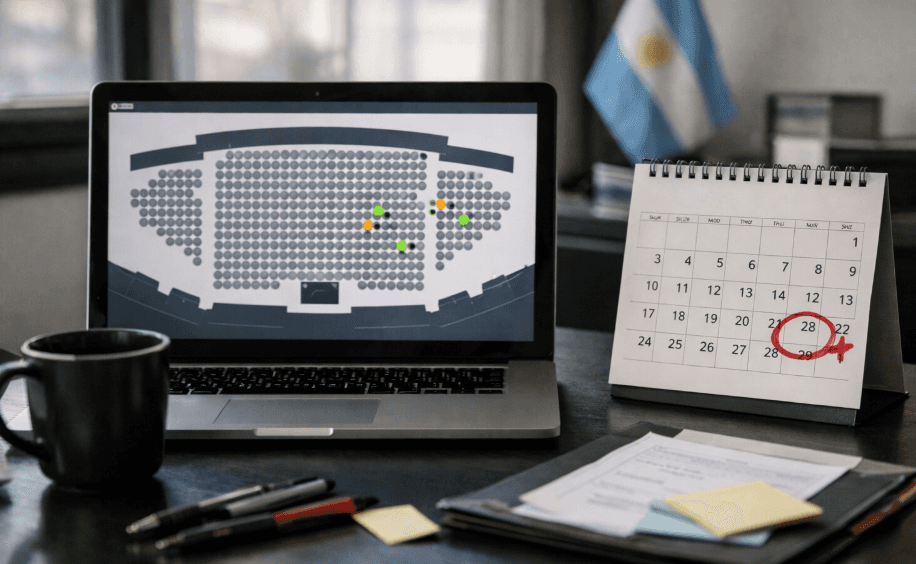
Most event organizers in the US face the same problem: audiences show interest, engage with posts, share event announcements, but don't buy tickets until the last minute. Or worse, they never buy them at all. Creating urgency in ticket sales isn't a marketing gimmick. It's a strategy based on understanding how buyers make decisions and designing the sales process to make acting now more attractive than waiting. This article explains how to build that urgency in a real, measurable, and sustainable way.
What is real urgency in ticket sales
Real urgency is the buyer's perception that delaying their purchase decision has concrete consequences. It's not a banner saying "last tickets" when 500 are still available. It's not a generic countdown timer that resets every week. It's a mechanism that connects time or availability with a tangible change in what the buyer receives.
In event ticket sales, urgency works differently than in traditional e-commerce. A physical product can be bought tomorrow, next week, or next month. A ticket has an expiration date: the event happens on a specific day, and after that date there's no second chance. This natural condition should facilitate urgency, but in practice, it's not enough. Buyers know the event has a date, but they assume they can buy "later". And that "later" is where conversions are lost.
Real urgency operates when the ticket sales system is designed so that each passing day without purchasing means a concrete loss for the buyer. Not an invented loss. A real loss.
Why people don't buy tickets even when they're interested
Understanding why audiences delay is the first step in designing effective urgency. The problem is almost never lack of interest. The most common reasons are different.
The illusion of infinite availability. If buyers perceive that tickets will always be available, they have no reason to hurry. This happens when there are no clear signals of scarcity or when event communication doesn't convey that availability is limited.
No consequence for waiting. If buying today and buying in three weeks gives exactly the same result, the brain chooses to wait. Not from disinterest, but because humans naturally tend to postpone decisions that have no immediate penalty. In behavioral psychology, this is known as present bias: we prioritize the immediate over the future.
Choice overload. In the US, especially in major cities like New York, Los Angeles, and Chicago, event offerings compete for audience attention. When there are too many options available, buyers enter decision paralysis and choose nothing.
Distrust in the purchase process. If buyers don't recognize the platform selling tickets, if the process has technical friction, or if payment methods (like Stripe, Apple Pay, or ACH transfers) aren't familiar, that discomfort becomes an excuse to postpone.
The cultural habit of "I'll check later". In the US market, there's a marked tendency to buy tickets close to the event date, especially for festivals like Coachella or SXSW where last-minute decisions are common. Breaking this pattern requires offering concrete reasons to buy early.
Each of these factors can be addressed with specific strategies through ticket sales system configuration and event communication.
The 4 triggers that create real urgency in ticket sales
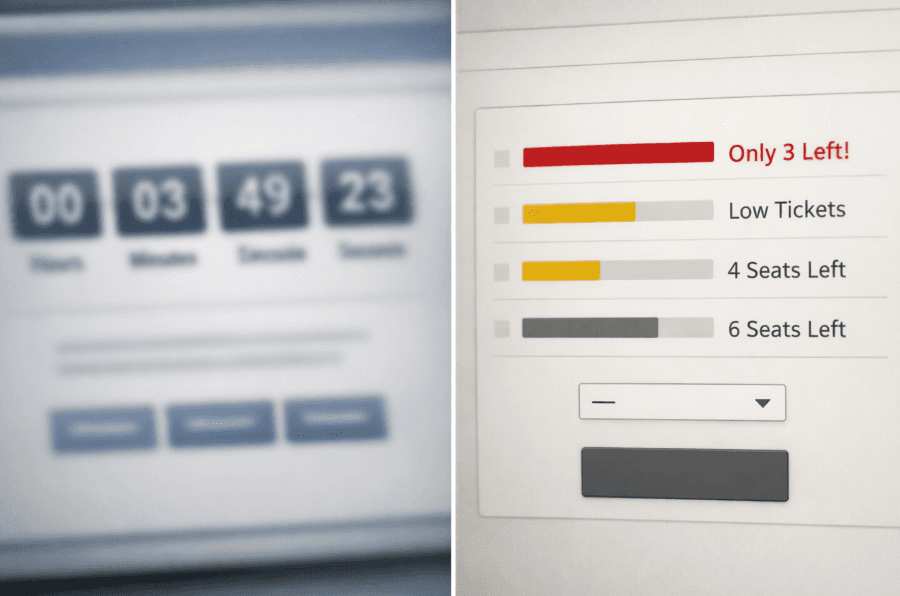
Not all urgency mechanisms are equal. Some work because they appeal to real principles of human behavior. Others fail because they're artificial and audiences detect them.
These four triggers work when implemented with honesty and consistency.
Real ticket scarcity
Scarcity is the most powerful trigger, but only works when it's true. If you communicate "last 10 tickets" and your event has capacity for 500 people, you're destroying trust, not generating urgency.
Real scarcity is built in several ways. The first and most direct is genuinely limiting the number of tickets per sales stage. If your event has capacity for 300 people, you can release 100 tickets in a first wave, 100 in a second, and 100 in a third. Each wave is truly limited, and when they're gone, they're gone.
The second way is scarcity by category. You can offer a reduced number of tickets with specific benefits (early access, preferred seating, meet & greet) and transparently communicate that this category has limited capacity. When it's sold out, buyers who waited lose access to that benefit.
The key is that the sales system reflects scarcity in real-time. If buyers enter the page and see 12 tickets remaining in a category, that generates genuine pressure. If the system doesn't show updated availability, scarcity is invisible and loses effect.
Time with consequence
Time only generates urgency when it has consequences. Saying "buy before Friday" without explaining what happens after Friday is noise.
Time with consequence means that a purchase condition changes on a specific date. For example: until Sunday you can choose seating on the venue map; starting Monday, seats are assigned automatically. Or: until a certain date the ticket includes access to an additional area; after that date, access is general admission only.
What's important is that the consequence is real and followed through. If you announce that a sales phase closes on Tuesday and it's still open on Wednesday, your audience learns that your deadlines mean nothing. And the next time you communicate urgency, no one will react.
Ticket sales systems that allow configuring stages with automatic opening and closing dates facilitate this mechanism. Automation eliminates the temptation to "extend" a deadline because sales weren't as expected.
Early bird benefits
This trigger isn't based on what buyers lose, but on what they gain by acting early. It's a positive approach to urgency.
Early bird benefits can take several forms. One of the most effective is tiered pricing with differentiated benefits. The first tier gets access to benefits that the second doesn't have. We're not just talking about price differences, but experiential advantages: better seating, access to exclusive areas, soundcheck entry, downloadable content, or any element that adds perceived value.
Another form is exclusive information access. Those who buy in the first stage receive lineup details, schedules, or event updates before anyone else. This turns early buyers into a privileged community.
Early bird benefits work especially well for recurring events where there's already a base of loyal buyers. If you know who bought in previous editions (because you have that data in your own database), you can offer them early access to sales as a reward for their loyalty. This reinforces both urgency and loyalty simultaneously.
Intelligent reminders for hesitant buyers
There's a percentage of buyers who visit the sales page, look at options, maybe start the purchase process, but don't finish. They're not uninterested: they're hesitant. And hesitant buyers need a nudge, not pressure.
Intelligent reminders work when the sales system automatically identifies these users and sends them relevant communication. Not a generic "don't forget your purchase" email. A message that reinforces the event's value, shows how many tickets remain in their category of interest, or reminds them that the current stage's benefits are about to close.
Ticket sales platforms that integrate automated remarketing with artificial intelligence allow executing this without manual organizer intervention.las tendencias de IA aplicadas al ticketing The system detects user behavior, segments according to interaction level, and triggers appropriate communication. Fanz, for example, includes this functionality within its platform, identifying visitors who didn't complete purchases and automatically retargeting them through email and social media.los datos de compradores de tickets
The difference between intelligent reminders and spam is relevance. The message must provide information the buyer didn't have or reinforce an element they were already interested in. Everything else is noise.
How to implement real urgency from your ticket sales system
Urgency doesn't just live in Instagram captions or stories. The most effective urgency is integrated into the sales infrastructure. This means your ticketing system must allow you to configure urgency mechanisms operationally, not just communicate them.
Automatic opening and closing tier configuration. Your system should allow you to create multiple sales stages with defined start and end dates. When a stage closes, it closes automatically. No need to manually enter the panel to change anything. This automation guarantees consistency: what you communicated gets fulfilled.
Real-time stock visibility. Buyers need to see how many tickets remain available. A real-time availability indicator at the moment of purchase is more effective than any urgency copy on social media. Real information generates more pressure than rhetoric.
Segmentation by purchase behavior. If your platform lets you know who visited the sales page without buying, who abandoned the process midway, and who bought in the first hour, you have the raw material to create segmented and relevant urgency communications.
Integrated remarketing tools. Urgency needs reinforcement. Buyers who saw your event but didn't purchase need to receive reminders before the current stage closes. If you have to export data, upload it to another platform, and create manual campaigns, urgency loses timing. Systems that integrate native remarketing (email, social media retargeting) allow executing this with speed.
Own domain and coherent purchase experience. Urgency is enhanced when the purchase experience conveys trust. If buyers click on your "last tickets" story and land on a domain they don't recognize, with branding that isn't yours, the trust friction neutralizes the urgency you had built. Selling from your own domain, with your branding, reinforces coherence between what you communicate and what buyers experience.tu propia plataforma de tickets con marca blanca
Common mistakes that destroy urgency in ticket sales

Creating poorly executed urgency is worse than not creating it at all. These are the most common mistakes event organizers in the US make.
Lying about availability. Saying "last tickets" when 70% of capacity remains. Casual buyers might not notice, but repeat customers do. And one detected lie destroys the credibility of all your future urgency communications.
Countdowns that don't count anything. A clock on the sales page saying "sale closes in 3 days" without explaining what happens when it closes. Does anything change? Is there a next stage? Do tickets run out? If the countdown has no consequence, it's decoration.
Extending deadlines you announced as final. "Last day to buy early bird" followed by "by popular demand, we're extending early bird one more week". It's tempting when sales don't meet expectations, but the damage to your credibility is cumulative and irreversible.
Urgency without accessibility. You generate urgency but the purchase process has friction: doesn't load on mobile, payment methods are limited, checkout requires too many steps. Urgency motivates buyers to act, but if action is difficult, motivation dissipates.
Communicating urgency only on social media. Social media is a channel, not the system. If urgency only exists in your stories but the sales page doesn't reflect scarcity, tiers, or deadlines, there's a disconnect that confuses buyers. Urgency must be in the sales infrastructure, not just in communication.
Not segmenting the message. Sending the same urgency email to someone who already bought and someone who never visited your page is inefficient and erodes your contact list. Effective urgency speaks differently to those who almost bought, those who didn't look, and those who already have their tickets.
How to measure if urgency is working
Urgency isn't an abstract concept. If it's well implemented, it produces concrete data you can monitor.
Temporal sales distribution. Observe how sales are distributed over time. If 80% of your tickets sell in the last 48 hours before the event, urgency isn't working. A more balanced distribution (with peaks at the start of each tier and at each stage's close) indicates that urgency mechanisms are moving the needle.
Conversion rate by stage. Compare conversion rates between different sales stages. If the first tier (with early bird benefits) has similar conversion to the third tier (without benefits), the perceived value of acting early isn't clear enough.
Cart abandonment by urgency trigger. Track how many users start the purchase process but don't complete it, segmented by which urgency trigger brought them to the page. If scarcity messages bring visitors who abandon more than benefit messages, you need to adjust the balance.
Email open and click rates on urgency campaigns. Urgency emails should have higher engagement rates than regular promotional emails. If they don't, either the subject lines aren't conveying urgency effectively or your audience has learned to ignore your urgency communications.
Revenue per visitor over time. If urgency is working, you should see revenue per visitor increase as deadlines approach, not just traffic spikes. More visitors with the same conversion rate isn't urgency - it's just more promotion.
These metrics tell you not only if urgency is working, but which type of urgency works best for your audience and event type. Use this data to refine your approach for future events.
Tags